

Rising material costs and ongoing supply chain volatility are putting increased pressure on packaging operations. Companies are looking for ways to reduce cost, but performance failures can be more expensive than the material itself.
Cost reduction and performance aren’t mutually exclusive.
By focusing on data-driven adjustments such as optimizing stretch film, improving machine efficiency, and reducing material waste, companies can see significant savings while still protecting their product.
Shorr helps you identify where stretch film performance is non-negotiable and where smart optimization can deliver both operational and financial benefits.
Performance Requirements That Cannot Be Compromised
The number one purpose of stretch film is to prevent damage and shifting during transit, handling, and storage. Therefore, any evaluation of cost-cutting adjustments in material should keep load containment as a top priority.
Load containment happens to be an area where companies tend to waste material. To prevent this, we recommend load containment testing to ensure you use just enough material to achieve your goals. The upfront investment in testing can bring significant savings, especially during times like these with rising material costs. Shorr’s access to performance testing labs can help its partners downgauge their stretch film use.
Material Savings Without Sacrificing Performance
Reducing material usage is important when determining how to offset rising costs. This will not only lower material costs, but also help optimize your freight and reduce exposure to Extended Producer Responsibility (EPR) fees. Automation, machine performance, and overall operational efficiency are other areas to consider.
- Downgauging: A stretch film’s gauge is a measure of its thickness. Higher numbers indicate stronger and thicker films. Depending on your application, you may be able to downgauge, or decrease film thickness, and still maintain performance while reducing the materials used.
- Gauge Optimization: If your operation is limited by wrap speed, evaluate the film gauge for your specific application. By increasing the gauge, you’ll require fewer revolutions, which increases throughput and uses less plastic.
- Improve Yield: Alternatively, you can evaluate the percent stretch of your current gauge to see if you can increase stretch to generate greater film yield. For example, if you are only getting 100% stretch, you may be able to extend it for optimized performance. Many films are designed to perform best at 200% stretch.
- Gear-to-sprocket Ratio: Upgrading the gear to sprocket ratio can improve stretch film efficiency if it increases or stabilizes pre stretch performance. Higher effective ratios will produce a higher pre-stretch percentage which results in less wasted film and better load containment.
- Increase roll length: When you opt for a longer stretch film roll, there is less downtime for roll changeovers, which increases throughput.
Case Study: Shorr Helped a Food Distributor Optimize its Stretch Film Usage
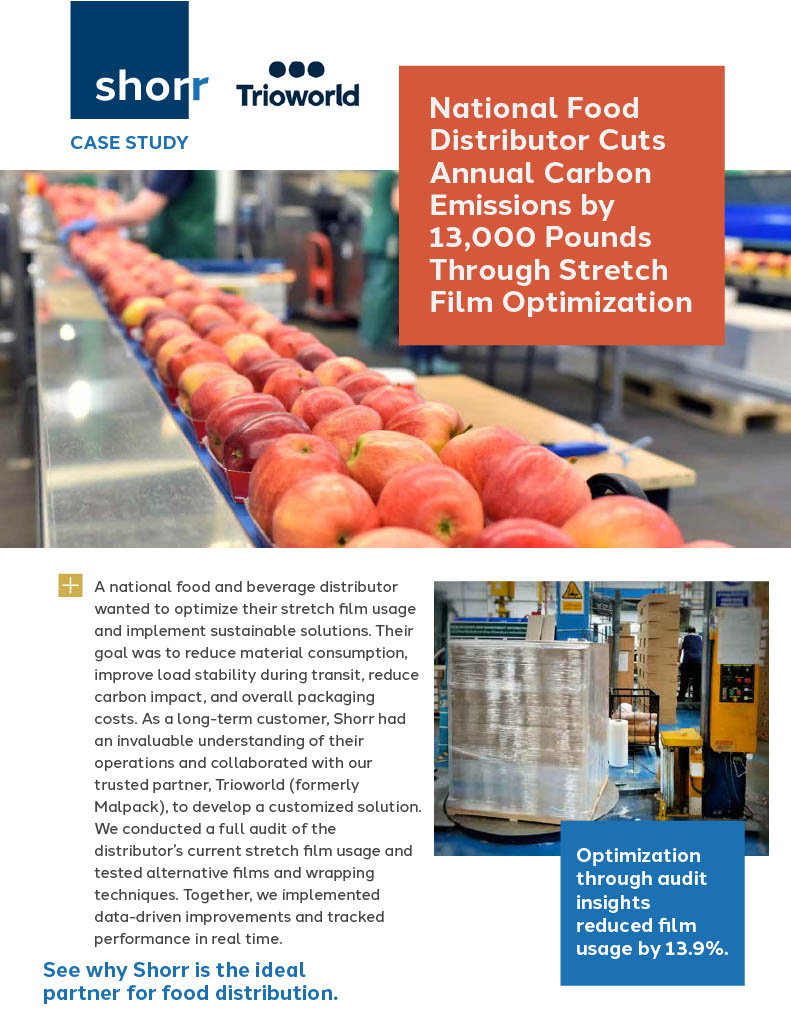
By conducting an audit, Shorr analyzed load containment, wrap patterns, and machine capabilities. Based on the results, Shorr recommended switching from 55 ga to 45 ga high-performance film – reducing material usage without compromising quality. The distributor enabled a 43% improvement in measured load containment and increased film yield, resulting in fewer roll changes and improved uptime.
Closed Loop and Recycling Opportunities
End-of-life management is another area where many companies are realizing savings.
Creating a closed loop system where plastic films are recycled or repurposed can reduce waste disposal costs and decrease EPR fees.
Recycling stretch film requires access to specialized recycling facilities. To address this, Shorr maintains a broad network of sustainability partners and can connect you with the resources needed to handle end-of-life recycling and repurposing.
Protecting your Operations and Bottom Line
Even in an unpredictable global environment, there are tools you can use to help manage rising costs and supply challenges. With the right information, you’ll be able to implement changes that not only solve today’s challenges but also help optimize your stretch film processes for long-term savings.
At Shorr, we validate and test our recommendations before implementation to ensure a successful outcome. Our team uses stretch film analysis tools that allow us to measure stretch and containment force, so changes don’t introduce new risks. From downgauging to rightsizing, material reduction, and exploring recycling opportunities, we help protect your products while improving efficiency and sustainability. Our goal in this volatile market is to help you maintain optimum performance while managing cost and operational stability.
Contact an expert to see how Shorr can help optimize your stretch film and equipment.