
Sustainable packaging is playing an increasingly important role in how consumers shop. Data from this year’s Sustainable Packaging Consumer Report also suggests its influence is growing.
From recyclable materials to reduced plastic and minimal packaging, consumers are paying attention to how the products they purchase are packaged. But compared to a year ago, are shoppers putting even more emphasis on sustainability when deciding what to buy?
According to the data surfaced in our report, the answer is yes.
For the second consecutive year, we surveyed more than 2,000 U.S. consumers about their sustainable packaging preferences, purchasing habits, and expectations for brands and retailers. The results reveal growing demand across several key areas.
Nearly two-thirds (62%) of the consumers surveyed say they’ve consciously purchased products with sustainable packaging in the past six months, up from 54% in 2025. Additionally, 93% said they are more likely to buy from brands and retailers that offer sustainable packaging, up from 90% last year.
From shopping habits to increased brand loyalty, this new data shows sustainable packaging is playing a growing role in what products consumers choose and which brands they support.
Key Highlights:
- 62% of consumers consciously purchased products with sustainable packaging in the past six months, up from 54% in 2025.
- More than half (52%) chose one product over another because of its sustainable packaging, up from 47% last year.
A majority of consumers (93%) are more likely to purchase from brands and retailers that offer sustainable packaging, up from 90% in 2025. - 46% are willing to pay more for products with sustainable packaging, compared to 43% last year.
- 78% are open to switching brands because a competitor offers sustainable packaging, up from 73% in 2025.
- 63% say sustainable packaging encourages repeat purchases rather than just a one-time buy.
- 90% would purchase more sustainably packaged products if they were more widely available, up from 87% last year.

Consumer Behavior
While a majority of consumers consciously purchase products with sustainability in mind, availability and cost remain barriers for some. More than one-third of respondents say limited availability (36%) or higher costs (35%) prevent them from purchasing more products with sustainable packaging. Another 19% cite a lack of clear sustainability labels, while 10% point to concerns about greenwashing.
However, 90% say they would purchase more products with sustainable packaging if they were more widely available, up from 87% in 2025.
Awareness & Preferences
As sustainable packaging becomes more important to consumers, clear labeling can also influence purchasing decisions.
Three-quarters (75%) say they prefer products with clear symbols or language indicating sustainable packaging, up from 70% in 2025.
Consumers vary in how closely they pay attention to these labels. One in five (20%) say they always notice sustainable packaging labels, while 60% sometimes notice them. Another 20% say they never notice whether packaging is labeled as sustainable, down from 25% last year.
For some consumers, a lack of sustainable packaging labels can impact whether they purchase a product. Overall, 21% say they have avoided purchasing a product because its packaging was not labeled as sustainable. Gen Z (25%) and Millennials (24%) were the most likely to do so.
More than two-thirds (69%) of consumers expect the brands and retailers they purchase from to offer sustainable packaging in 2026.
Recyclability & Consumer Preferences
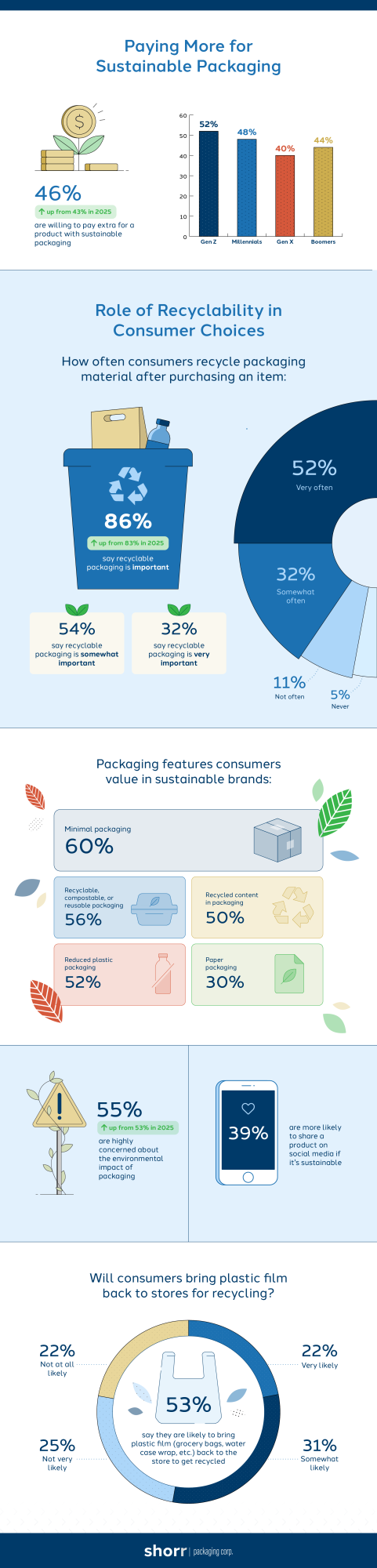
While cost remains a barrier for some shoppers, nearly half (46%) of consumers are willing to pay a premium for sustainable packaging, up from 43% in 2025.
Younger consumers are the most willing to pay extra. More than half of Gen Z (52%) say they would pay more for sustainable packaging, followed by Millennials (48%), Boomers (44%), and Gen X (40%).
Role of Recyclability in Consumer Choices
Recyclability remains an important factor for consumers. More than 4 in 5 (86%) say recyclable packaging is important when making purchasing decisions, including 32% who consider it very important. That’s up from 83% of consumers who considered recyclable packaging important in 2025.
Consumers are also regularly recycling packaging after making a purchase. More than half (52%) say they recycle packaging materials very often, while another 32% do so somewhat often. Just 16% say they rarely or never recycle packaging.
The report highlights that 60% of the consumers surveyed value minimal packaging, while 56% value recyclable, compostable, or reusable materials. Reduced plastic packaging (52%) and recycled content (50%) round out the features consumers value most.
However, recycling behavior can depend on what consumers are required to do. Just over half (53%) say they would be likely to bring plastic film, such as grocery bags or water case wrap, back to a store for recycling. That includes 22% who are very likely to do so and 31% who are somewhat likely.

Sustainable Packaging & Brand Loyalty
Sustainable packaging can influence which brands consumers choose and continue to support.
Nearly 4 in 5 (78%) consumers say they would be open to switching brands if a competitor offered sustainable packaging, up from 73% in 2025. In fact, 40% say they have already switched to a competing brand because it offered sustainable packaging.
Sustainability can also drive repeat purchases. Nearly two-thirds (63%) say sustainable packaging encourages them to purchase from a brand again rather than make a one-time purchase.
Nearly two-thirds (63%) favor brands that have publicly announced sustainability goals, up from 58% last year. Gen Z is the most likely to favor these brands at 70%.
Additionally, 63% say they are more likely to recommend or review products with sustainable packaging, up five percentage points from 2025.
Which Industries Are Leading in Sustainable Packaging?
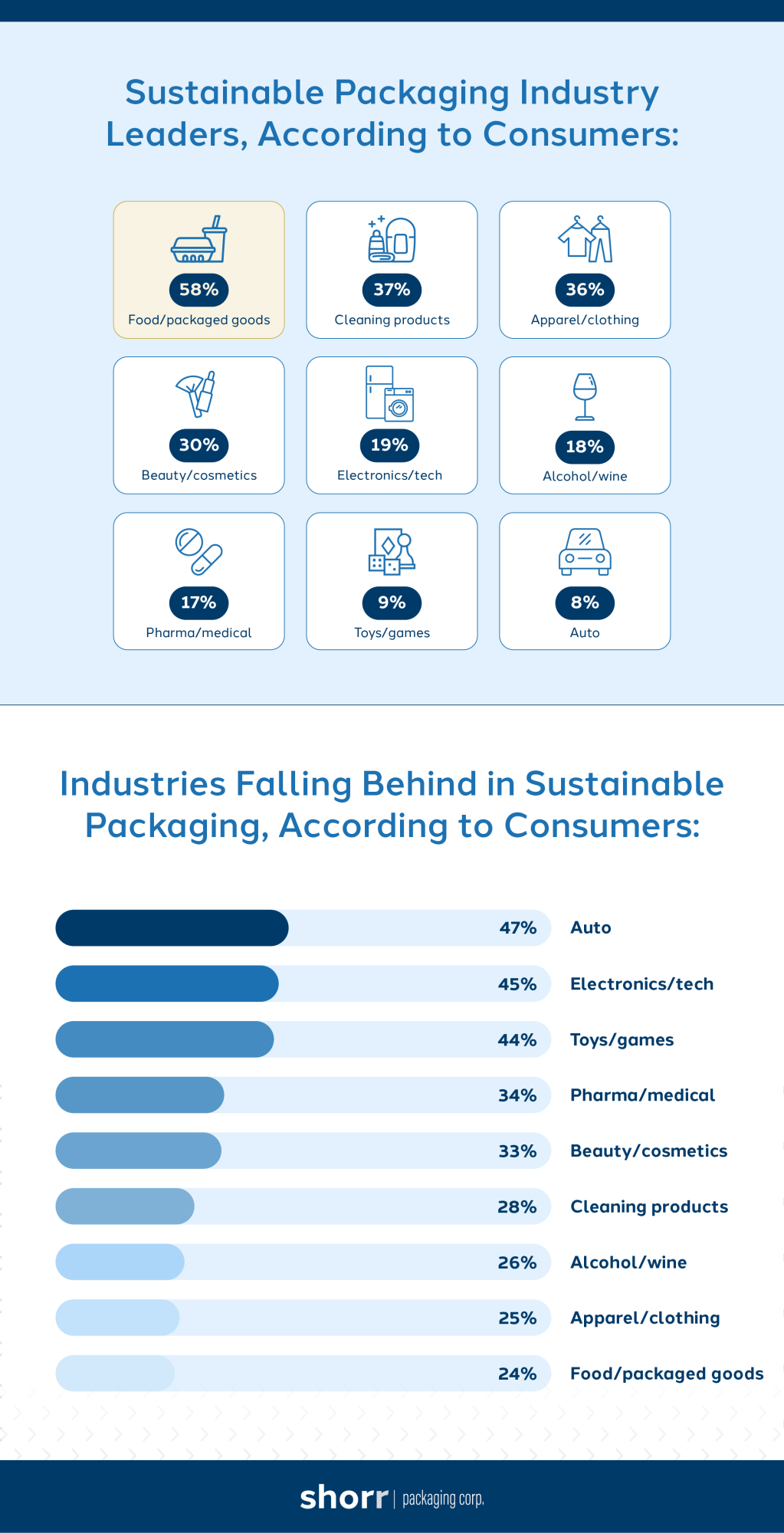
According to consumers, some industries are doing a better job than others when it comes to sustainable packaging.
The food and packaged goods industry stands out, with 58% of consumers saying it leads the way in sustainable packaging. Cleaning products (37%), apparel and clothing (36%), and beauty and cosmetics (30%) follow.
On the other end of the spectrum, nearly half (47%) of consumers say the auto industry is falling behind in sustainable packaging. Electronics and tech (45%) and toys and games (44%) round out the industries consumers believe have the most room for improvement.
Interestingly, food and packaged goods ranked both as the industry most associated with sustainable packaging and the least likely to be viewed as falling behind. Just 24% of consumers believe the industry is lagging when it comes to sustainable packaging.
Consumer Actions
The environmental impacts of product packaging remain a concern for consumers in 2026. More than half (55%) of consumers surveyed say they are highly concerned about its environmental impact, up slightly from 53% in 2025.
Sustainable packaging can also influence how consumers engage with products after making a purchase. Nearly 4 in 10 (39%) say they are more likely to share a product on social media if it’s sustainable.
As consumer expectations continue to evolve, the report highlights the importance of brands understanding what shoppers value in sustainable packaging, including reducing unnecessary packaging, using recyclable materials, and clearly showcasing attributes on the packaging.
For more information on Shorr’s sustainable packaging solutions and how we help brands meet consumer demand while reducing environmental impact, click here.
Methodology
In August and September 2026, we conducted a nationwide survey of 2,038 U.S. consumers. This survey explored consumer preferences for sustainable packaging, generational differences in eco-conscious behaviors, and the role of packaging in driving brand loyalty and purchase decisions. Respondents were asked about their purchasing habits, willingness to pay for sustainable packaging, recycling behaviors, and expectations for brand sustainability commitments.
Gender: Female (50%), Male (49%), Non-binary/non-conforming (1%), Transgender (<1%), Prefer not to respond (<1%)
Age Range: 18–84 (average age: 46)
Income Levels: Under $25,000 (17%), $25,000–$34,999 (11%), $35,000–$49,999 (13%), $50,000–$74,999 (22%), $75,000–$99,999 (14%), $100,000–$149,999 (15%), $150,000 or more (8%)
Marital Status: Married (38%), Single (33%), In a Relationship/Not Married (13%), Divorced (12%), Separated (1%), Widowed (3%)
Total respondents: 2,038
Margin of error: +/- 3%
Country: United States (USA)
Region: All Regions
Gender: All Genders
Age of respondents: 18–84