

This guide is intended to help explain the continuous evolution of sustainable packaging design regulations, with a focus on recyclability labels. It will examine SB 343 and provide clarity on other labeling standards, including Resin Identification Codes (RIC), and other labels you might commonly recognize on packaging materials.
Regulations continue to emerge across the U.S. One of the most impactful is California’s SB 343, which goes into full effect for packaging manufactured after October 4, 2026. This bill outlaws the “chasing arrows” and other recycling directions and indicators often seen on packaging unless specific criteria are met. CalRecycle, California’s Department of Resources Recycling and Recovery, states that the goals of this legislation are to:
- Help vendors and consumers make informed decisions about products.
- Provide an objective basis for holding manufacturers, distributors, and retailers responsible for misleading consumers about whether products get recycled.
As a result, this change in labeling is expected to increase demand for recycling infrastructure and recycled content, reinforcing the “closed loop” recycling system. Additionally, any fines collected as a result of non-compliance will be reinvested into improving statewide recycling infrastructure.
This guide is intended to explain the changes coming under SB 343, and provide clarity on other labeling standards, including the resin codes and other labels you might see commonly on packaging materials.
Association of Plastic Recyclers Guidance on Potential Labeling Conflicts
The Association of Plastic Recyclers (APR) published guidance on SB 343, noting that 37 states currently have RIC laws in place for plastic packaging, and out of those, 29 states require chasing arrows symbols. SB 343 may conflict with some of these state requirements, and it is recommended that manufacturers work with legal counsel to review these conflicts.
How California’s SB 343 Is Redefining Recyclability Labeling for Packaging
From 2023 to 2024, CalRecycle commissioned a statewide study at material recovery facilities to identify which materials are commonly collected and sorted for recycling in California. The goal of this study was to establish a baseline of materials that are widely recyclable at facilities across the state and are collected for recycling in most residential areas.
Following this study, new criteria for labeling were developed to ensure more clarity for consumers and to streamline the process of packaging recycling. Based on the new requirements, packaging may only display the chasing arrows symbol if its material and format meet four criteria: Access, Sorting, Design, and Safety.
- Access: Material is collected for recycling by jurisdictions that cover 60% of the state population.
- Sorting: Materials can be sorted into defined streams by recycling facilities that:
- Collectively serve at least 60% of statewide recycling programs.
- Reclaim them consistent with the Basel Convention.
- Design: Packaging or components do not render package “Non-Recyclable” under the APR Design® Guide.
- Safety: Product or package does not contain heavy metals or added PFAS at or above 100 ppm.
Additionally, SB 343 includes an update to the Resin Identification Code law, amending the 1988 law. The law still requires resin identification for rigid plastic bottles and containers based on the base material; however, the code must now be placed in a solid triangle, rather than the chasing arrows, unless the containers meet the four criteria mentioned above.
CalRecycle published a list of materials that address criteria 1 (Access) and 2 (Sorting), however; it is up to the manufacturer to determine whether their packaging meets categories 3 (Design) and 4 (Safety).
Fiber Packaging Compliant with Categories 1 and 2
- Corrugated cardboard (Clean and uncoated)
- Office paper and mail
- Newspapers and magazines
- Paper bags, kraft paper, folded paper containers/paperboard packaging
- Clean molded paper fiber
- Gable top cartons
- Aseptic containers
Metal Packaging Compliant with Categories 1 and 2
- Aluminum cans and lids
- Beverage cans and bottles
- Foil sheets and foil-molded containers
- Tin/steel beverage containers
- Aerosol containers
- Other ferrous/non-ferrous metal
- PET (Clear and pigmented)
- HDPE/LDPE (Clear/Natural and pigmented)
- PP (Clear/Natural and pigmented
- Any glass container (Clear and colored)
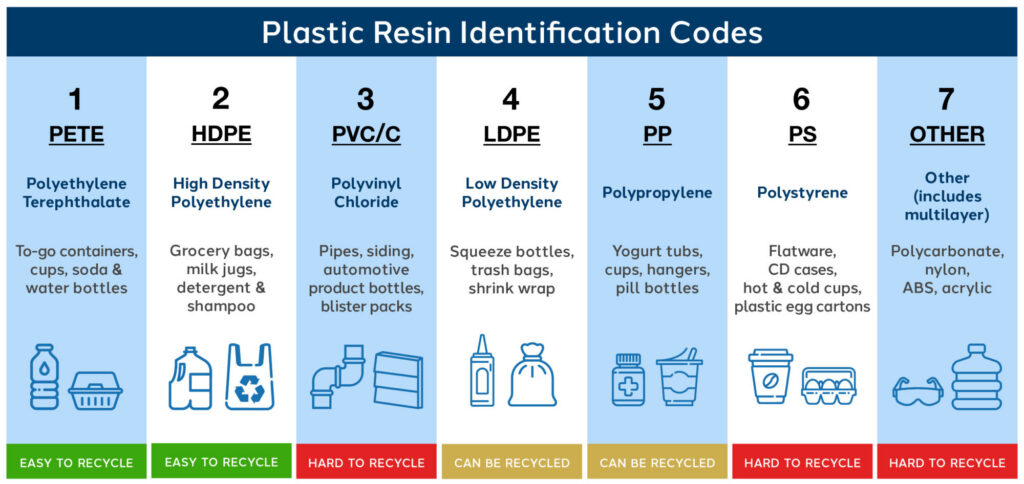
The resin codes that align with this are 2, 4, & 5.
Displayed below is a key to the Resin Identification Codes, along with a graphic demonstrating the different end products often made with each resin. It also indicates which items are more challenging to recycle.
How2Recyle’s New Labeling Guidelines
How2Recycle (H2R) is the organization behind the widely recognized recycling labels that can often be found on packaging. H2R is a standardized system of on-pack labeling operating in the U.S. and Canada. It aims to provide clear information and direction for packaging end-of-life management, to improve recycling quality and reduce contamination.
After CalRecycle completed its study, H2R established a new labeling guide to indicate recyclability in California.
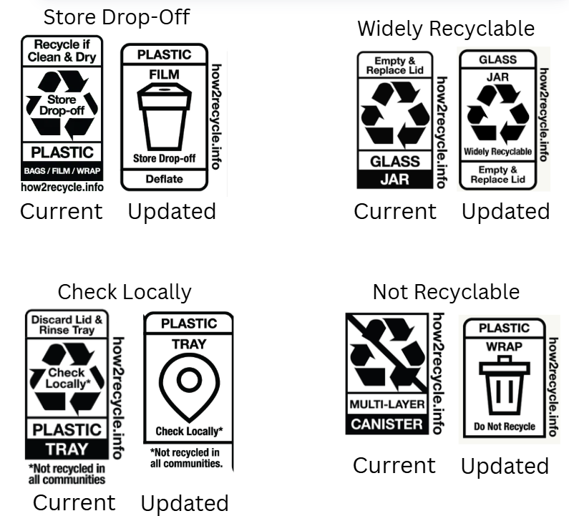
The new labels are called “Pro” Labels, while the older versions are now referred to as “Legacy” labels. These Pro labels were launched in September of 2025. The four key label changes are highlighted below. Brands are required to be members of “How2Recycle” to apply for these labels.
Next Steps to Comply With Evolving Packaging Recyclability Regulations
The hard deadline to transition to the H2R Pro labels is October 4, 2026. All packaging manufactured after this date and sold in California must further comply with SB 343.
February 1, 2026, was the last date that any proof using “Legacy” labels would be approved. After this date, all H2R label requests are required to be submitted using Pro labels. Manufacturers are required to maintain documentation to prove any recyclability claims made about their packaging and be able to provide documentation upon request.
New Members
Companies looking to add How2Recycle labels to their packaging for the first time will not have access to Legacy labels and must use Pro labels instead. Additionally, packaging must comply with SB 343’s recyclability criteria to make recyclability claims or use the chasing arrows label.
Existing Members
Companies that already use How2Recycle labels should conduct internal audits to determine whether each packaging item meets SB 343 recyclability criteria. Based on the results, a corresponding Pro label should be added to the packaging.
Alternative Packaging Labeling Options
Manufacturers have other options for labeling materials.
- Text-based instructions: Producers may use phrases to instruct consumers on how to properly dispose of the material.
- Digital/QR-based labeling: QR codes are an option for more specific, detailed instructions for disposal, including location-specific information.
- Triangles (without arrows where appropriate): Manufacturers are free to use a solid triangle for resin codes that do not comply with the recyclability criteria of SB 343.
- Compostable packaging: Manufacturers can explore the How2Compost label. This label is only used on packaging that is certified compostable by the Biodegradable Products Institute (BPI) and helps consumers identify such packaging.